Foundation and connectivity
Networking, segmentation, VPN, virtualization and structural services create a manageable and predictable foundation.

Evo PS proprietary platform
It integrates infrastructure, security, identity, connectivity, data, monitoring and continuity into a single operational architecture.
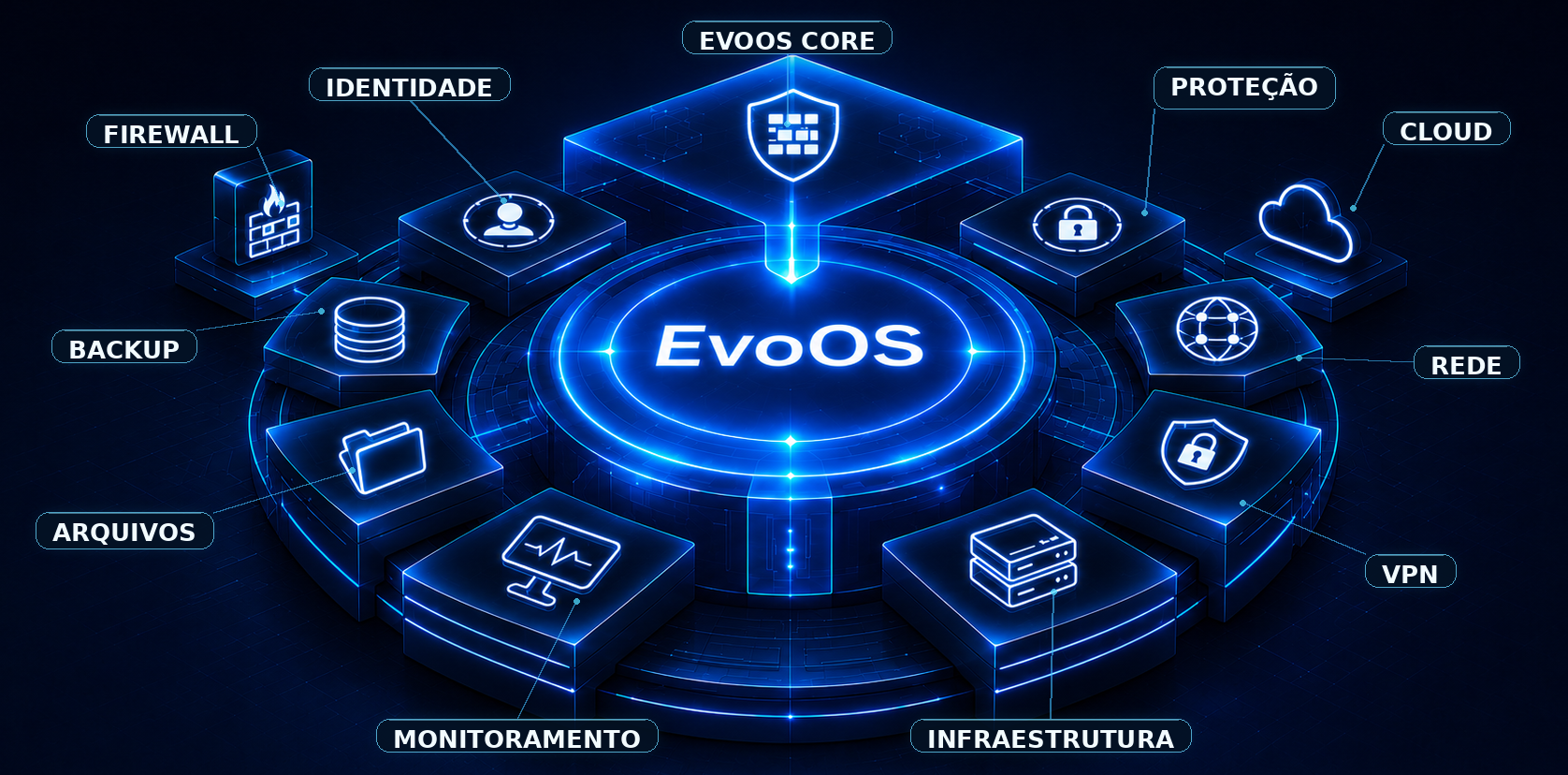
Operational architecture
EvoOS is not valuable because it gathers tools on one screen, but because its layers share policy, identity, observability and operations.
Networking, segmentation, VPN, virtualization and structural services create a manageable and predictable foundation.
Firewall, service protection, identity, authentication and access controls reduce exposure and excessive privilege.
Backups, databases, applications, collaboration and files are managed within the same operating model.
Monitoring, alerts, logs, restoration and continuity procedures complete the operating cycle.
Capabilities
EvoOS in operation
The screens below are from EvoOS running in production-like environments. Events and source addresses observed by the defensive layer are retained as operational evidence; only Evo PS internal infrastructure information is hidden when necessary.

Network events are consolidated to help identify patterns, sources and abnormal behavior.

Honeypot, scanning and other defensive decisions can be monitored and managed from an operational view.

Blocked events are presented with enough context for operations without relying on an isolated tool.

Daemon status, updates, signatures and scan execution appear in a single administrative view.

EvoOS verifies groups of system controls and provides a structured process to validate and correct deviations without exposing the complete baseline recipe on the public site.

CrowdSec decisions appear alongside EvoOS native enforcement, allowing operators to track external signals and locally maintained blocks.
Security note: the defensive events shown are real evidence of EvoOS operations. Source addresses interacting with defensive mechanisms are not treated as internal information; Evo PS infrastructure data, credentials, administrative identity and detailed baselines remain protected.
Operations
That is why EvoOS combines platform, monitoring, support and continuous evolution.
Continuous monitoring of availability, events and critical signals. This does not mean unrestricted human support: support coverage follows the contracted plan.
Scope, hours, priority and service levels are defined according to criticality and business needs.
Updates, improvements, risk reviews and expansion are treated as an operational cycle, not as isolated projects.
Use cases
Centralized services, security, identity and backup with lean operations.
VPN, identity, policies and coordinated connectivity across sites.
Integration of on-premises resources, cloud and remote access with governance.
Monitoring, recovery, advanced controls and continuity planning.
Subscriptions
Plans guide the capability level. Final scope is defined after understanding the environment, criticality and business objectives.
A secure technical foundation for starting managed operations.
Integrated services and data for a more complete operation.
Governance, continuity and architecture for more demanding environments.
Advanced security, vulnerability and protection controls according to scope.
Capability comparison
A simple self-assessment reference. Final design depends on the environment, technical dependencies and contract.
| Capability | Foundation | Business | Enterprise | Security+ add-on |
|---|---|---|---|---|
| Managed, standardized foundation | ✓ | ✓ | ✓ | — |
| Continuous monitoring | ✓ | ✓ | ✓ | — |
| Support according to contract | ✓ | ✓ | ✓ | ✓ |
| Business services, data and backup | — | ✓ | ✓ | — |
| Expanded continuity and governance | — | — | ✓ | — |
| Vulnerability, WAF and advanced protection | — | — | — | ✓ |
✓ capability included at this level · — not part of the standard scope. Security+ is an advanced security add-on to a base plan; it does not replace Foundation, Business or Enterprise.
FAQ
No. The platform is available only as an Evo PS managed subscription, with monitoring and support according to contract.
Not necessarily. The design considers the existing environment. The goal is to reduce complexity and integrate operations, not replace technology without a reason.
Yes. Monitoring is continuous. Human support, response time and operational coverage depend on the contracted level.
Yes. It can integrate on-premises resources, cloud, branches and remote access according to the project.
Simulate up to 10 days of downtime, estimate measurable financial impact and identify business areas and controls that can increase or reduce exposure.
Executive estimate. No credentials or sensitive technical information.